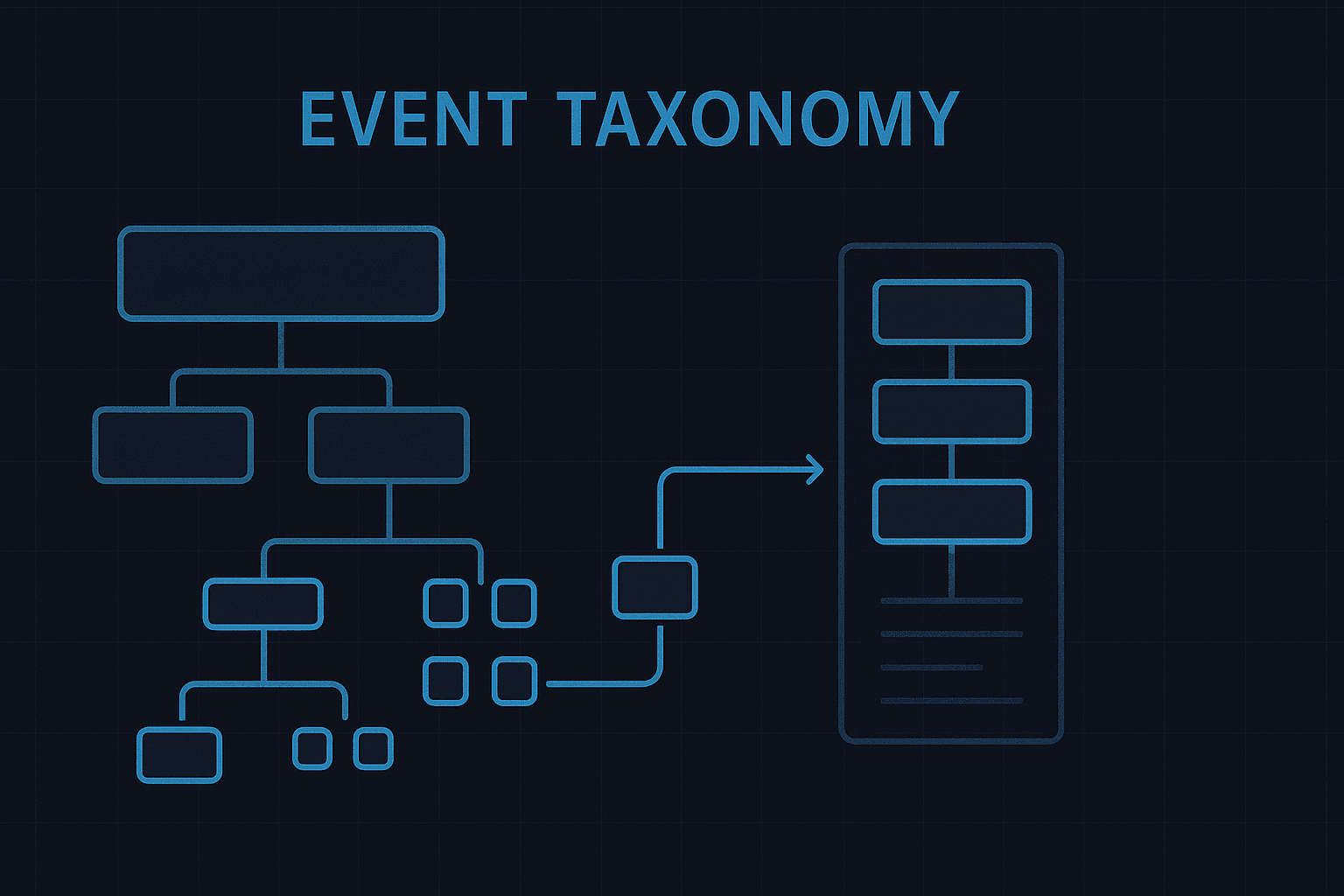
Event Taxonomy Design: How to Structure Audit Events for Clarity and Scale
Building a unified and scalable event grammar for audit logging
How to design a clear, consistent, and scalable event taxonomy for audit trails, enabling reliable analysis, compliance evidence, and system wide understanding.
Event Taxonomy Design: How to Structure Audit Events for Clarity and Scale
An audit trail is only as useful as the clarity of the events it contains. Without a well defined event taxonomy, audit logs quickly become inconsistent, unclear, and difficult to analyze. Teams may describe the same action in different ways, attach different metadata, or omit critical context. Over time, this leads to confusion, gaps in compliance evidence, and unreliable forensic information.
Event taxonomy design is the process of defining a structured, consistent grammar for audit events. It sets the rules for how events are named, formatted, categorized, and enriched with metadata. A strong taxonomy makes audit logs easy to interpret, easy to query, and easy to verify at scale.
This article explains how to build an event taxonomy that supports clarity, consistency, and long term scalability.
Why a Clear Event Taxonomy Matters
Consistency Across Teams and Systems
Modern applications often consist of many services, modules, and teams. Without a unified taxonomy, each team invents its own event formats. This leads to:
- duplicate event types
- inconsistent naming
- missing metadata
- difficulty correlating events across systems
A taxonomy establishes a shared language that all teams follow.
Reliable Auditability and Evidence
Compliance frameworks expect consistent evidence. An event taxonomy:
- ensures required fields are always present
- prevents ambiguity
- improves the reliability of audit exports
Clear event definitions strengthen compliance posture.
Faster Forensics and Incident Response
A well structured audit trail allows investigators to:
- trace user actions
- identify risky behaviour
- correlate system changes to incidents
An unclear taxonomy slows investigations significantly.
The Components of an Event Taxonomy
A mature event taxonomy addresses all aspects of event design.
1. Event Names
Event names should follow a consistent pattern. A common approach is:
actor.action.resource
Examples:
- user.login
- user.logout
- user.updated
- admin.permission.changed
- project.created
- customer.exported
Naming conventions should be:
- lowercase
- dot separated
- verb oriented
- unambiguous
2. Event Types and Categories
Events should be grouped into categories to support filtering and reporting.
Common categories:
- authentication
- authorization
- data access
- data modification
- administrative actions
- configuration changes
- exports
- imports
Assigning categories helps with:
- role based visibility
- compliance reports
- filtering in event explorers
3. Required Fields
All audit events should contain a core set of fields. These fields create consistency across all services.
Required fields include:
- event_id
- timestamp
- actor_id
- actor_type
- action
- resource_type
- resource_id
- tenant_id (for multi tenant systems)
- context metadata
- previous_hash
- hash
4. Optional Fields
Different event types may require additional fields. Optional fields may include:
- request_id
- IP address
- user agent
- device information
- before and after values
- change deltas
- reason codes
Optional fields must be clearly defined in the taxonomy for each event type.
5. Metadata Structure
Metadata should use a predictable format. Use nested JSON objects rather than free form strings.
For example:
``json { "actor": { "id": "user_123", "role": "admin" }, "resource": { "type": "project", "id": "p_456" }, "changes": { "name": ["Old Name", "New Name"], "status": ["pending", "active"] } } ``
Using structured metadata simplifies downstream analysis and machine learning.
Designing Events for Clarity
Use Verbs for Actions
Events should describe what happened in plain language.
Good examples:
- user.login
- user.password_reset
- customer.created
- invoice.paid
Avoid cryptic or overly technical events.
Avoid Overloaded Events
One event should represent one action. Avoid using a single event to mean several different things.
Capture Context Instead of Guessing Later
Context lost at the time of the event cannot be reconstructed later. Capture:
- reason codes
- request metadata
- user agent
- geographic information
Ensure resource types are descriptive and accurate. For example:
- "customer" rather than "object"
- "invoice" rather than "transaction"
- "permission" rather than "setting"
Scaling the Taxonomy Over Time
Taxonomies evolve. Systems grow, new event types appear, and some become obsolete.
To maintain long term clarity:
- use versioning in event schemas
- maintain a formal event registry
- document each event type
- deprecate event types with clear timelines
Sharing a central registry is essential in distributed teams.
Designing Event Schemas for Automation
Event taxonomies can drive automation:
- automatic validation of event fields
- generation of documentation
- SDK event helpers
- compliance reporting templates
A machine readable taxonomy enables consistent enforcement across languages and services.
Taxonomy Anti Patterns
Several common mistakes should be avoided:
- free form or unstructured metadata
- relying on log messages instead of structured events
- inconsistent timestamp formats
- combining unrelated actions into a single event
- failing to version event changes
- using internal service names in event names
Examples of Well Designed Events
User updates their email address
``typescript event: user.updated; actor_id: user_123; resource_type: user; resource_id: user_123; changes: email: ['old@example.com', 'new@example.com']; ``
Admin modifies permissions for a team member
``typescript event: admin.permission.changed; actor_id: admin_9; resource_type: user; resource_id: user_456; changes: role: ['viewer', 'editor']; access_scope: ['read', 'read_write']; ``
Conclusion
A strong event taxonomy is foundational to trustworthy audit trails. It creates clarity, removes ambiguity, and makes event data reliable for compliance, forensic investigation, and system analysis. By defining event naming rules, required fields, metadata structures, and versioning strategies, teams establish a durable audit framework that grows with the product.
A good taxonomy is not a documentation artifact. It is a contract between teams, a technical enforcement mechanism, and a long term investment in the integrity of the system.