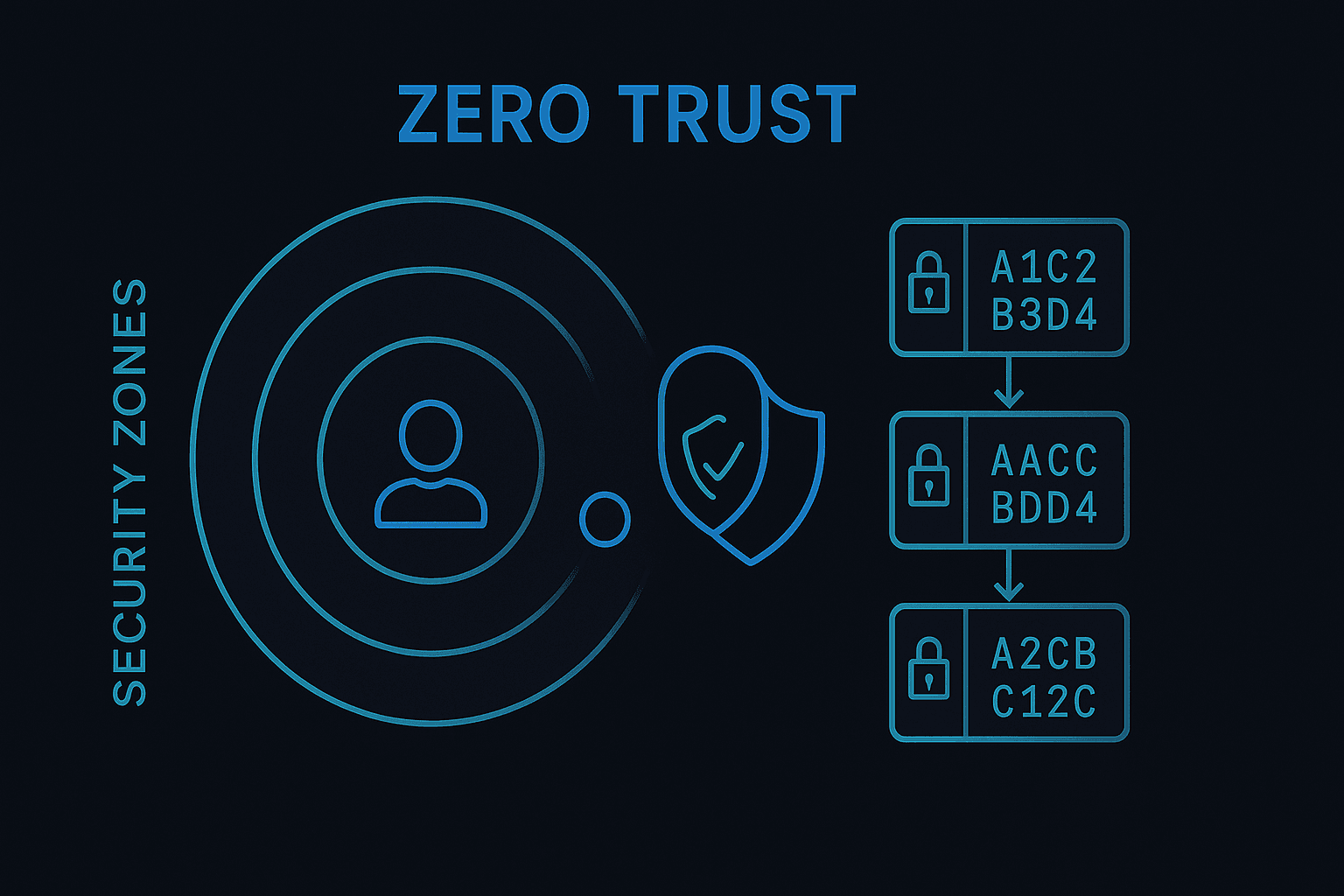
How Audit Trails Strengthen Zero Trust Architecture
Why visibility and verification are essential pillars of modern Zero Trust systems
A detailed exploration of how audit trails support Zero Trust principles by improving verification, reducing lateral movement risk, and strengthening access control decisions.
How Audit Trails Strengthen Zero Trust Architecture
Zero Trust architecture has become a central security model for modern organizations. Its core principle is simple: never trust, always verify. However, implementing Zero Trust is not just about strong authentication or microsegmentation. A critical but sometimes overlooked component is the audit trail. Without trustworthy, structured, and immutable audit logs, Zero Trust systems cannot verify access, enforce policies, or respond to threats.
This article explores the relationship between Zero Trust principles and audit logging, why the two are inseparable, and how audit trails act as the backbone of verification.
Understanding Zero Trust
Zero Trust is a security architecture that assumes no implicit trust anywhere in the system. All access must be authenticated, authorized, and continuously validated. Some core tenets include:
- Continuous verification
- Least privilege access
- Assumption of breach
- Strong identity and device controls
- Segmentation and isolation
- Context aware access decisions
Zero Trust is not a single technology. It is a combination of policies, identity controls, network controls, device posture checks, and contextual analysis.
Why Audit Trails Matter in Zero Trust
Zero Trust requires real time understanding of:
- Who is requesting access
- What they are attempting to do
- Whether their behavior is normal or suspicious
- How access aligns with policy
- When actions deviate from expected patterns
Audit trails are the primary source of this visibility. Without audit logs, Zero Trust becomes guesswork instead of verification.
Visibility is foundational
Zero Trust assumes that anything in the environment can be compromised. Therefore, organizations must observe all actions within the system to validate behavior and detect anomalies.
Audit trails provide:
- High fidelity event histories
- Correlated timelines across systems
- Evidence that supports access decisions
- Data for behavioral analytics
Without them, visibility gaps undermine Zero Trust outcomes.
Verification requires evidence
Zero Trust replaces implicit trust with explicit verification. This requires authoritative evidence that an entity has the right to perform an action.
Audit trails provide that evidence.
For example:
- Confirming a device posture check
- Tracking privilege elevation
- Validating policy enforcement
- Detecting denied access attempts
- Recording sensitive data access
With structured logs, Zero Trust systems can rely on factual records instead of assumptions.
Detecting lateral movement
One goal of Zero Trust is to slow or eliminate lateral movement. Attackers frequently shift between systems using stolen credentials or misconfigurations.
Audit trails detect patterns like:
- Login attempts across multiple services
- Sudden privilege escalation
- Accessing new resources without prior history
- Unusual volumes of data export
- Access from unfamiliar IP addresses
- Attempts to bypass segmentation boundaries
The faster investigators can detect lateral movement, the lower the impact of breaches.
Strengthening policy enforcement
Zero Trust policies might include rules like:
- Only devices with current patches may access sensitive data
- Access must be re verified after a period of activity
- Admin privileges require explicit approval
Audit logs provide the data needed to:
- Confirm that policy checks occurred
- Validate whether enforcement succeeded
- Identify gaps in policy execution
- Provide evidence during audits or compliance reviews
Supporting continuous authentication
In Zero Trust, authentication is not a one time event. It must be continuous. This requires tracking user actions, device posture, environmental signals, and behavioral context.
Audit trails support:
- Adaptive authentication
- Session risk scoring
- Identity threat detection
- Rapid session revocation
A system that cannot observe user behavior cannot adaptively trust or revoke access.
How Weak Audit Trails Undermine Zero Trust
Organizations often claim to implement Zero Trust but neglect the audit layer. This creates a false sense of security.
Incomplete logs lead to blind spots
If logs do not capture sensitive actions, Zero Trust becomes ineffective. For instance:
- Missing logs for data access
- No records of configuration changes
- Limited tracking of cross system actions
- No correlation between identity and resource
These gaps become opportunities for attackers.
Inconsistent logs reduce signal quality
Zero Trust benefits from structured data. Logs that lack standard fields reduce the ability to:
- Detect anomalies
- Classify events
- Enforce policies
- Trace incidents across systems
Without a consistent schema, logs become noise rather than insight.
Mutable logs eliminate trust
If logs can be altered or deleted, they cannot be used to verify behavior. Zero Trust requires immutable evidence. Without it, attackers can cover their tracks or manipulate events.
Poor retention limits analysis
Zero Trust assumes attackers may dwell for long periods before being detected. Short retention windows hide the early signs of an attack.
Designing Audit Trails for Zero Trust Environments
A Zero Trust aligned audit system should provide:
Comprehensive event coverage
Include:
- Authentication events
- Authorization decisions
- Device posture checks
- Role and permission changes
- Administrative actions
- Data access
- Failed attempts
- Lateral movement signals
- Policy enforcement events
Structured event formats
Use structured schemas that contain:
- Actor
- Action
- Resource
- Timestamp
- Outcome
- Environment details
Immutable storage
Audit logs should be tamper evident through cryptographic hash chaining or write once storage.
Correlation across systems
Zero Trust spans multiple systems. Audit logs must unify timelines across them.
Near real time accessibility
Detection requires rapid access to event data.
Retention based on risk
Security and compliance requirements should dictate how long logs must be stored.
How HyreLog Enhances Zero Trust
HyreLog provides capabilities that complement Zero Trust architectures:
- Immutable hash chained audit logs
- Structured event schemas across systems
- Workspace and project isolation
- High throughput event ingestion
- Queryable timelines
- Exports for compliance
- Support for identity and access events
Zero Trust policies rely on evidence. HyreLog provides that evidence with the consistency and integrity required for modern security models.
Conclusion
Zero Trust architecture is only effective when it is backed by reliable, structured, and immutable audit data. Audit trails provide the visibility and verification needed to enforce policies, detect threats, and reduce the impact of breaches. Without them, Zero Trust collapses into a theoretical model without operational grounding.
Organizations seeking to strengthen their Zero Trust posture must invest in audit logging as a foundational capability, not an optional feature. The more trustworthy the audit trail, the stronger the Zero Trust environment becomes.